On Saturday 30th July 1966, my father was arriving into King’s Cross station from Aberdeen. He looked for a taxi and couldn’t understand why there was no one around. At the same time, Geoff Hurst was scoring England’s fourth goal to win the World Cup Final against West Germany. I still find it amusing that he had no idea this momentous occasion in English sport was happening!
This month the Football World Cup has kicked off in America, to the delight of billions and a collective groan from those less enthusiastic about “the beautiful game’. I might hazard a guess here, but many of those who might read this blog probably fall into the latter camp. I should confess, however, that along with church wandering I have a passion for the round ball game. But even I find the prospect of 104 live matches way too daunting, thank goodness for a few minutes of highlights. So, to spare you hundreds of words on my latest wanderings, I propose giving you a few highlights of my own. Every church I visit may look similar – a tower, a nave and a chancel, a clerestory, a porch – but each is unique and has some feature that makes it memorable and distinct.
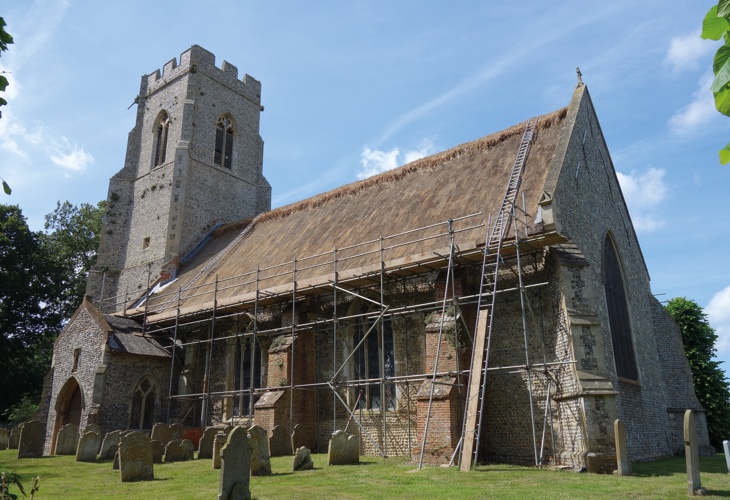
St Mary, Whissonsett (main image)

An attractive church, set back from the main road, the body of the building is Early English, but the restored church is more Decorated and Perpendicular. Tucked into a niche on the right of the chancel arch is a large head of a Saxon wheel cross that was dug up in the early 20th Century. Not unusual in some parts of Britain, it is a rare artefact in Norfolk. The cross is intricately carved, over a thousand years old, and was possibly part of an early preaching cross used before the church was built. The green in front of the church is known as the campingland. Nothing to do with tents and caravans, this was an area where the locals played ‘camping’, an extremely rough and violent free-for-all that was the ancestor of modern football.
St Andrew, Metton
Seemingly squeezed into its churchyard, there are two arches at the foot of the 14th century tower that formed a processional way, a rare sight in this part of the county. A simple, aisleless 14th century church, there are some gorgeous roundels of Flemish glass in the east window inserted in the 1960s.
Attached to the north wall is an old parish truncheon dating from the reign of William IV. Maybe this had been used to keep some sort of order on the local Camping field!


St Mary, Rougham
Norfolk is rich in memorial brasses, some of them staggeringly large such as in the Minster in King’s Lynn or St Margaret, Felbrigg. As many seasoned church visitors will know, under pieces of old carpet may lie these pictorial commentaries of four centuries of our history, customs, dress and fashion. St Mary has some treats hidden up in the chancel. A series of memorials to the Yelverton family, one of whom, a certain Sir William, was executor to Sir John Fastolf, a name blended by Shakespeare for his jocular knight, Sir John Falstaff, in his Henry IV plays. Alongside is a tiny brass to two small children. These are John and Roger Yelverton who died in 1505 and 1510. They are swaddled in the ‘Chrysom’ cloth in which they would have been baptised. A tragic reminder of the infant mortality rate of medieval England.


St Bartholomew, Brisley
The fine tower of St Bartholomew soars 100 feet above the village of Brisley. This is another of Norfolk’s large perpendicular churches and remained largely free from the hands of Victorian restorers. The interior is full of delightful features and fittings. Over both doors are traces of St Christopher paintings, with that on the south wall also faintly showing two other figures, possibly St Bartholomew and St Andrew. A glimpse of St Christopher was supposed to keep one safe on your journey that day, this church certainly had all angles covered. There are lovely old low benches with traceried backs and amusing bench ends including one of a dog with a goose in its mouth. The three-decker pulpit is delightfully rustic and reflects three centuries of adaptation.


The most memorable part of the church is the crypt under the altar, accessible through a door to the north. You climb down some stairs and enter an empty space, clean and light, this was once the charnel house where bones were stored on removal from a grave, allowing re-use of the plot. It is also believed that the space was used as a holding cell for prisoners on their way from King’s Lynn assizes to the gallows in Norwich. It is hard to stop a chill running down your spine.
St John, Terrington St John

This is an area rich in huge, architecturally impressive churches, and St John is slightly the poorer cousin to the likes of the Wiggenhalls and Tilney All Saints. The interior is light, wide and pleasing with an impressive 17th century font holding centre stage. Yet it is one part of the exterior of the church that takes the breath away and makes a visit a real must. Perched improbably between the base of the tower and the west of the south aisle is the ‘priest’s house’. It has rooms at ground level and first floor level with passages overhead that lead to the tower and the roof. Perhaps it was built to house a priest as travel was so difficult through the watery fens? Looking at it from afar, there is something industrial about it, reminding you of a large grain store or the Maltings on Wells quayside. A most unusual, yet pleasing, sight.
St Andrew, Tangier

In the spirit of the World Cup, my final highlight this month is over a thousand miles away from Norfolk, but an Anglican church nonetheless. Consecrated in 1905, St Andrew sits in the bustling port city of Tangier. Never one to miss out on a church visit, I attended Sunday service with friends and a small but tight knit group of parishioners. The church is a lovely mix of the familiar and the exotic, somewhere between a church and a mosque. The tower is in the style of a minaret and Islamic-style carvings frequent the whole building. The most obvious example is the Lord’s Prayer in Arabic spanning the arch between nave and chancel. There are memorials and gravestones that hark back to the last days of Empire and beyond, reminiscent of such cemeteries from the Indian subcontinent to the Middle East and North America. Chatting to a local after the service, the conversation drifted to the forthcoming World Cup. He was adamant that this year Morocco would stun the world – watch this space!

Rob Gladstone June 2026