Throughout the year, our friends across the pond have been celebrating the 250th anniversary (semiquincentennial) of the adoption of the Declaration of Independence on July 4th 1776. After a rocky start that included the British burning down the White House in 1814, for many years the USA and United Kingdom have been the staunchest of allies and friends. The roots between the two nations clearly go back well before 1776, with waves of settlers leaving our shores, including household names such as John Rolfe, he of Pocahontas fame, and Thomas Paine being just two examples.
These two men were Norfolk men and the myriad of connections between the county and the USA are still obvious today. There is no better place to be made aware of this than the historical repositories in our churches and graveyards. During World War II there were 18 USAAF bases and at least 50,000 American personnel at any one time based in the county. The memorials to those who never returned are poignantly evident everywhere. From the many Norfolk settlers on the Mayflower to RAF Feltwell today, the links are as strong as ever.
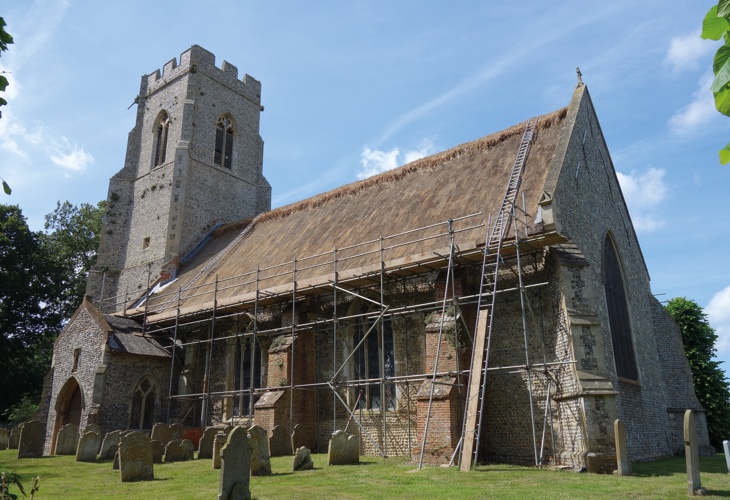
There are two churches I have visited recently which have a strong bond with Uncle Sam. The first is St Andrew, (main image) a fine, statuesque church in the large village of Hingham, just to the north of Attleborough.
On approaching the church, we find our first American connection, a memorial to the 452nd Bomb Group who flew Flying Fortresses from Deopham Green airfield. They suffered heavy losses, particularly in 1944, losing 110 aircraft in action and their sacrifice is remembered today.

At fifty metres long, St Andrew is a large church that in most other counties would be considered huge. Built in the 1350s, predominantly in one seamless campaign, the style is mostly Decorated with elements of the new, emerging Perpendicular style. The tower is enormous, with great windows of flowing tracery and a grand western door with an elegant ogee hood.
The scale of the interior is equally impressive. The lovely 14th century arcades are wide and spacious, and the tall nave is finished off with a stunning hammerbeam roof from 1872. There is much Victorian restoration throughout that gives the interior a slight urban feel without being too heavy-handed.
One’s eye is instinctively drawn down the nave to the east window, one of the two standout features in this church. Donated in 1813 by Lord Wodehouse, all the glass is German, from the 1500s and supposedly purchased from a nunnery in the Netherlands. Comprising four separate windows merged into one, the style is distinctive and almost garish but packs one almighty punch.


Nearby, in the north wall of the chancel is the real treasure of the church. This is the Morley tomb, described by Pevsner as ‘one of the most impressive wall monuments of the 15th century in the whole of England’. An astonishing piece made from red sandstone, it towers the full height of the chancel and includes an Easter Sepulchre at its base. Thomas, Lord Morley, Marshal of Ireland died in 1435, and his family is linked to medieval England’s glorious past including the victories at the sea battle of Sluys in 1340 and the battle of Crecy in 1346.


In the north aisle we renew our American connection in the great personage of Abraham Lincoln. A handsome bust of the great US President tells of his familial connections with Hingham, where for many generations the Lincolns would have worshipped in this church. It was Abe’s great-great-great grandfather, Samuel, an apprentice weaver in Norwich, who in 1637 braved the voyage to the New World. Just for continuity’s sake, he settled in a small town in Massachusetts called Hingham, and the rest is history!

The Lincoln connection does not end at Hingham, as the next church I visit is All Saints, Swanton Morley. One of Abe’s ancestors, Richard Lincoln, lived in the village and there is evidence that he was a church warden between 1599-1620. It is believed his house was on the site of the Angel Inn.

Swanton Morley was also the site of an RAF base, now an army base, and on Independence Day 1942 six American aircrews took part in the first official USAAF combat mission in the European theatre, flying from here with six RAF crews to attack targets in occupied Holland. General Eisenhower, the future President, had visited the airfield shortly before the raid.
The church itself has other similarities with Hingham. It is also a large, imposing church, but not necessarily for Norfolk, and was built in one long campaign.
Dating from the mid-14th century to the early 15th century, All Saints though is clearly built in the Perpendicular style. The tower has massive octagonal piers at the base with huge bell openings covering at least half of the tower.
The site of the church is spectacular, sitting elegantly above the Wensum valley with exquisite views across the river and water meadows to the nearby St Peter, Bylaugh.

The south porch is relatively small and plain, but the inner doorway has two ranges of floral motifs in the mouldings and an elegant wicket door. On entering the church there is immediately a feeling of calm, light and space.
The original brick floor is aged and mellow and the clear windows allow the light to stream in. The aisles of the nave extend to embrace the tower which is supported by unusually large arches and huge pillars. The east window commemorates the life of Swanton Morley and there is also a commemorative window to RAF Morley with tributes to the US Army Air Corp.

The font is rather dwarfed at the foot of one of the giant pillars but next to it are some interesting, thick, deep grooves in the stonework. One fanciful explanation was the marks had been left by archers, sharpening their arrows. The most likely reason is slightly more mundane but gives a good insight into the medieval mind. Parishioners would scrape out stone dust and use it for medicinal potions as the whole building would be seen to have healing powers.
As these two wonderful churches show, the connections between America and Norfolk are manifold and cover over 400 years. They are evident in people and places both sides of the Atlantic. This relationship can at times be strained as political and economic forces come into play. The Lincoln memorial in Hingham carries the words of this great President and they still should guide us in the present day.
‘Malice towards none, charity to all.’

Rob Gladstone – September 2026