I first read J.R.R. Tolkien’s ‘Lord of the Rings’ as a 12-year-old and was instantly captivated. I must confess to having read it several times since and watched the films numerous times. The characters and different worlds created are dazzling, but one place in particular caught my imagination, the elvish city of Rivendell. Hidden in the foothills of The Misty Mountains, this place served as a sanctuary of healing and lore, and its remoteness kept it hidden from the world.
For better or worse, many of Norfolk’s exquisite medieval churches seem to be surrounded by a similarly invisible cloak and I often seem to stumble across them, hidden away in the bucolic countryside. So easy to miss, yet so satisfying and rewarding to find. On a recent wander near Diss, I (eventually) came across two such hidden gems, both beautiful in their own way.

Barely a mile from Diss station, the route to St Andrew, Frenze starts rather unpromisingly as you follow signs to a Business Centre. You then turn off onto a farm track and follow it through woods, eventually arriving at an old, seemingly disused, farmyard. There is often a slight feeling of trepidation visiting one of these remote churches, not knowing whether you are actually where you are meant to be or accidently trespassing.
An attractive farmhouse sits to the side of the yard and in the other corner, on a slight mound, is the small, atmospheric church glowing in the early evening sun. St Andrew’s is indeed small as the chancel fell into disrepair and was destroyed in 1827, leaving the 14th century nave making up the body of the church. There is no tower, simply an attractive bell cote added in 1900. The 16th century Tudor brick porch is a delight with part of the floor made up of medieval coffin lids and the entrance arch pinched at the bottom.

The interior is calm and simple, the light playing gently on the silvery white wooden furnishings in a delightful mix of the medieval and Jacobean. The 14th century octagonal font is decorated with relief designs like window tracery, each panel like a pattern for a trainee window mason. Above the north door hang surviving boards from a Stuart royal arms, their incompleteness seems fitting in this partial building.
Two pieces of Jacobean furnishing dominate the middle part of the nave. Made of creamy, untreated oak, the decorative box stall and pulpit and sounding board were most likely made by the same carpenter. It’s easy to imagine the priest of the day preaching loudly to the lord of the manor and his family, sitting just a few yards across the nave. This could have been the Nixon family who took over the estate in 1636, or the wonderfully named Blennerhassets, the previous owners.
It is the Blennerhassets who have left the largest imprint here, thanks to one of Norfolk’s most remarkable sets of memorial brasses. An unusual name, they appear in the renowned Paston Letters, where Sir John mocks that Ralph Blennerhasset is a name to start a hare! There are six figures still in the floor, the earliest from 1475 showing Sir Ralph in full armour.


The 14th century east window has a few pieces of medieval glass and underneath is a simple altar with a medieval mensa sitting on top. This stone slab has small cross shaped indentations, one at the centre and at each corner that represent the wounds of christ. As occurred in so many churches, this slab was removed during the Reformation, and this one was used for centuries as a doorstep. It was recovered during the 1900 restoration and reinstated as an altar.
One interesting story attached to this church caught my eye. Norfolk seems to have its fair share of misbehaving clerics, the best example being Harold Davidson at Stiffkey. The vicar of St Andrew’s in the early 19th century was George Wilson Bridges. The son of a wealthy banker, it didn’t take him long to cause a scandal when he eloped with Elizabeth Brooks and married at Gretna Green. He had to leave Frenze and spent much of his life in the West Indies and Canada, divorcing his wife and losing four daughters in a boating accident. He was a staunch defender of slavery and wrote articles attacking the abolitionist movement. He later befriended William Fox Talbot and was an early pioneer of photography. Unsurprisingly, there is no plaque to him in the church!


A few miles away from Frenze, and equally well hidden, is St Mary, Denton. I must have driven past three times, before finally crossing an impossibly narrow bridge, past a large manor house and parking below the church in a converted stable yard.
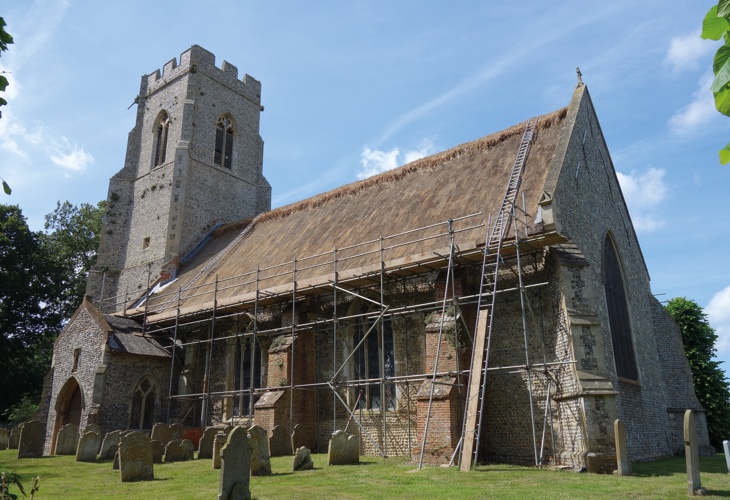
The first thing that strikes you as you climb up the steps into the churchyard is the eccentric church tower. This has been rebuilt on three occasions, each variation clearly visible. The original tower was a flint, Saxo-Norman round-tower, part still surviving. After partially falling in the 18th century, it had a red brick square tower stitched on. Finally, the Victorians added a flint, square top in 1843. All in all a very pleasing muddle of styles.

The church itself has been much restored inside but still has some remarkable features. The most extraordinary are the series of 15th century bosses in the north porch. Beautifully carved and sympathetically restored, they show the Annunciation, The Resurrection, The Nativity, The Ascension of Christ and The Coronation of The Queen of Heaven.

The church itself has been much restored inside but still has some remarkable features. The most extraordinary are the series of 15th century bosses in the north porch. Beautifully carved and sympathetically restored, they show the Annunciation, The Resurrection, The Nativity, The Ascension of Christ and The Coronation of The Queen of Heaven.


Inside the church one is immediately drawn to the large east window, full of 15th and 16th century English and continental glass with scatterings of medieval pieces throughout. The colours and figures are dazzling, from deliciously delicate roundels to two sets of Royal Arms. Indeed, if you include the other Royal Arms over the north and south doors this makes a total of four, more than any other church in East Anglia. The glass is here thanks to the early 18th century vicar, John Postlethwaite, who left the vast sum of £200 to install his collection.
Other surviving links to the distant medieval past include the famous Denton Chest. A 19th century construction, it was made to display a range of medieval panels depicting saints that most likely came from a rood screen, but the provenance has been lost in time. In the chancel is a strikingly decorative piscina and single seated sedilla that has been partially swallowed up by the Victorian restoration.
One trip, two hidden churches – the words of Bilbo Baggins spring to mind. “Not all those who wander are lost”. Searching out these wonderful Norfolk churches I often temporarily feel lost, but eventually they reveal themselves, as they have done for hundreds of years to the weary, the curious and the devout.
Rob Gladstone July 2026