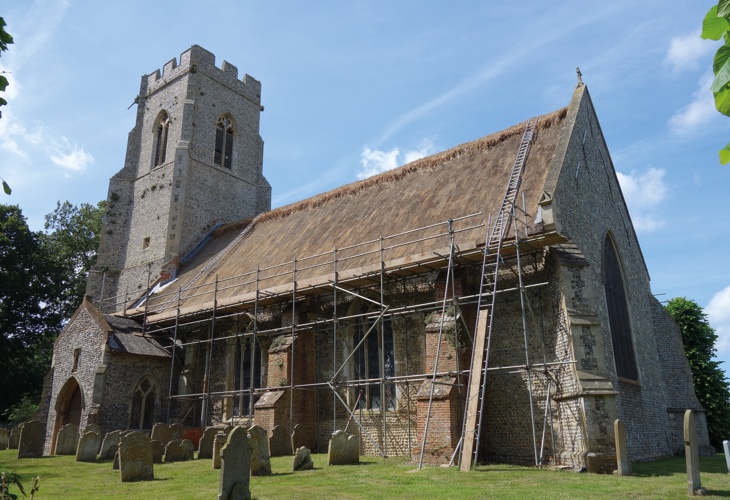
Hemblington All Saints.

The culmination of the Sacred Spaces: churchyards for nature event at St Andrew the Apostle Church, Holt on Saturday 10th October was the presentation of the inaugural Norfolk Churchyard Conservation Award. This was a collaboration between the Norfolk Churches Trust, the Norfolk Wildlife Trust, and the Diocese of Norwich.
Keynote Speaker, the Rt Revd Graham Usher, Bishop of Norwich, was on hand to open the envelope to reveal the winner of the 2026 award to Hemblington All Saints. He is pictured here presenting a specially carved oak plaque which the church received, along with a cheque for £1,000.
Ian Lonsdale, Trustee of the Norfolk Churches Trust, gave some background to the award.
As part of the Norfolk Churches Trust’s 50th Anniversary year, the Trust wanted to celebrate by ‘giving something back,’ as a legacy of this significant milestone. This included a Heritage Skills & Maintenance Day in April which introduced the skills and practical work that helps keep Norfolk’s historic churches standing strong. A Children’s School Art Competition which encouraged primary age children to visit their local church and produce pieces of art what they saw. It is our hope that it will inspire the next generation. The Trust is also introducing a Heritage Skills Scholarship and last but by no means least, Ian’s idea of the Norfolk Churchyard Conservation Award falls firmly within that legacy category.
We are delighted to announce that the Churchyard Conservation Award will become an annual event and we will be launching the 2027 award shortly. Who will follow Hemblington All Saints and win the award next year?

The Trust, working in partnership with the Diocese of Norwich, and the Norfolk Wildlife Trust, launched the Award earlier this year. Thirty-three entries were received, with one arriving at 15 minutes to midnight on deadline day! The spread of entries was across the county, and with much difficulty, due to the impressive standard of the entries, these were whittled down to a final four. The judging took place in May, and the final decision was extremely close. So much so, that all the other finalists were presented with Highly Commended Certificates.

The small round-towered medieval church of Hemblington, All Saints has two churchyards, both are managed to help provide a sanctuary for wildflowers and wildlife. The southern churchyard has been cut and raked by Blofield and District Conservation Group since 1985, whilst the northern churchyard is cut and raked by the Bure Valley Conservation Group. The regular cutting and raking ensures that wildflowers prosper, with the added benefits for birds, bees, butterflies, dragonflies, and visitors. Regular wildlife surveys by the Friends Group record the wildlife in and around the churchyard, the wildlife is thriving with over 100 species of birds and insects, 150 plant species and 16 kinds of trees at the last count.

The churchyard at Blofield contains unimproved grassland which supports an ancient hay meadow flora with an abundance of oxeye daisy, meadow vetchling, common knapweed, yarrow, and hairy tare. Mammals known to be present include pipistrelle bats, hedgehogs, and field vole. Tawny owls frequent the larger trees and common pheasant and red-legged partridge visit the site. Toads, grass snakes, and slow worms have also been recorded. A healing garden has been created at the base of the tower where there is a stone bench and herb garden.

All Saints, Edingthorpe is a rural church surrounded by agricultural land. The churchyard is a vital space for wildflowers to grow undisturbed by modern farming and for wildlife, particularly invertebrates. In early spring, yellow winter aconites and lesser celandine arrive followed by carpets of snowdrops, bluebells, and daffodils. The main event of spring and summer is the white, yellow, and red of pignut, buttercups, and sorrel, with tall grasses waving in the breeze. The churchyard is bordered by mature trees, with ten main species including oak, beech, and yew. Several species of butterfly can be seen. There are more than 70 species of fungi and many species of lichen in the churchyard.

Horstead, All Saints can be found close to the river Bure. On the north side of the churchyard is a conservation area that is 40 years old, started by Dr Bob Leaney who still keeps on eye on it. They have just started wildlife gardening on the south side of the church and are working on a sensory theme, planting will include bird and insect friendly species. Birds spotted in the area include a cuckoo, spotted flycatcher, kingfishers, heron, egret, and goldfinches. There are otters and water voles in the river and the churchyard hosts voles, field mice, moles, swallows and occasional deer. They host community events themed around nature. Families canoe, climb, make nest boxes, learn about the Broads, discover lichen and birds, as well as take part in eco boat races and wild foraging.
With grateful thanks to Frederic Landes for his photographs of the event.