With approximately 100 miles of coastline and easy access to the continent, it is hardly surprising that Norfolk has a rich maritime history. Indeed, for many centuries, sea travel was quicker and more convenient than the inland routes left to crumble after the withdrawal of the Roman Empire.

It was the sea that brought Christianity to Norfolk in the guise of St Felix of Burgundy, who legend tells us landed at Babingley, near Castle Rising in 630 CE. Many of Norfolk’s fine churches lie along the coast and they are full of memorials and memories of past seafarers and naval heroes. Nowhere is this more evident than in the story of Horatio Nelson, surely one of our greatest historical figures and the subject of my last blog. For better or worse, the seventeenth to nineteenth centuries were a time of empire building and derring-do on the high seas and alongside Nelson there was a cohort of other nautical figures connected to our churches and to each other.
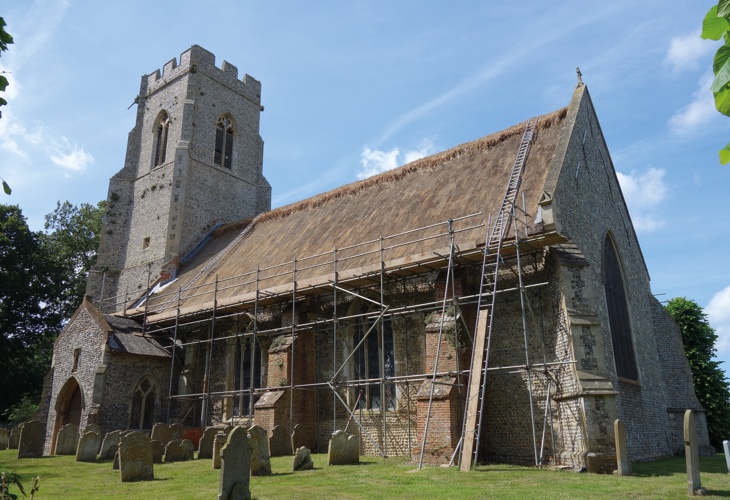
Standing like a sentinel above the salt marshes and looking down on the North Sea, St Nicholas at Salthouse (main image) is Perpendicular in style and built at the behest of the Heydon family. It is one of the coastline’s most spectacular churches and reflects the medieval wealth present in the ports of the Blakeney Haven. The weather-beaten porch with stone seats leads to the most gloriously light interior, all faded wood and stone floors. The nave and chancel are continuous under one roof with graceful, narrow windows in pairs keeping out the buffeting wind. The twenty-two clerestory windows and huge east window add to the feeling of height and light.


The interior fittings are numerous and spectacular, from the fifteenth century font, to the old poppyhead bench ends and the remains of the once vast screen now moved to the back of the church. Carved into the back of the screen and elsewhere in the chancel are numerous examples of graffiti, many depicting ships, that probably date to the late 16th century. Buried beneath the nave is one Mary Mings (Myngs), daughter of Vice-Admiral Sir Christopher Myngs (1625-1666).
Born in Salthouse, Myngs was of humble origin, the son of a shoemaker. He first came to prominence fighting for the Parliamentarian navy in the First Anglo-Dutch war (1652-54). He then commanded the frigate Marston Moor, helping to protect the new colonial asset of Jamaica. This was a time when the blurred line between being a buccaneer (for all intents and purposes a pirate) and a naval officer depended very much on your loyalties.
Myngs had great success raiding the Spanish Main and capturing prizes, but he seems to have kept much of the loot for himself and the buccaneers. He was arrested for embezzlement and returned to England in disgrace. Luckily for him, the Restoration was in full swing and he was reemployed in the Navy. He took part in the Four Days’ Battle (1666) against the Dutch but was shot in the face with a musket ball, dying a few days later.

Lying a few miles west of Salthouse is the small village of Cockthorpe and the church of All Saints, rescued in the 1970s by The Norfolk Churches Trust. At the fifteenth-century octagonal font the baptism of not one, but two, 17th century admirals took place – John Narborough (1640-1688) and Cloudesley Shovell (1650-1707). These two admirals were personally linked to Christopher Myngs, as I will explain below.

All Saints is a charming, small church that is predominantly from the fourteenth- and fifteenth- century, with some evidence of earlier stonework. It has a short chancel, with an aisle south of the nave and, more unusually, no windows in its north wall. On entering you first see the medieval wall painting of St Christopher in its customary spot on the north wall. Uncovered in the 1990s, a lovely detail is the images of the two donors kneeling at the bottom, one with a little dog. Beside St Christopher is another wall painting, this time a seventeenth-century, black-lettered set of the Ten Commandments. A legacy of the Reformation, these visibly demonstrate the shift from Catholicism to Protestantism and the change in the ways of worship.’

There are several other interesting furnishings in the church, none more mind-boggling than a grand marble memorial to Sir James Calthorpe and his wife, Dame Barbara. A lengthy inscription tells us that they had 8 sons and 6 daughters and Sir James died aged 57. Dame Barbara lived to the grand old age of 86, dying in 1639, and was “much comforted with the sight of 193 of her children and their offspring”.
There can be little doubt that John Narborough grew up knowing some of this vast Calthorpe family before his life at sea. This career began as a cabin boy on the ship of no less an admiral than Sir Christopher Myngs! It seems that he was present at the very battle that did for Myngs and then set off on a career of great importance. Explorer, navigator, consummate sailor and naval administrator, Narborough’s journal of his expedition to South America was recently valued at £800,000 and is seen as so important it was recently placed under a temporary government export ban.

After his death at sea from an unknown illness, Narborough’s wife, Elizabeth married Cloudesley Shovell, himself a former cabin boy, first under the tutelage of Admiral Myngs and then John Narborough! Shovell came to national prominence after an action against the pirates based at Tripoli. He became the leading fighting admiral of his age but in 1707 disaster struck.
Along with 2,000 men, Shovell drowned in a shipwreck off the Isles of Scilly, sadly demonstrating the desperate need for navigators to be able to accurately judge their longitude, something not possible until the 1760s. Family legend has it that Shovell washed up on the shore alive but was finished off by a local woman for the sake of the emerald ring on his finger.
Salthouse and Cockthorpe are but two of many Norfolk churches with intricate links to our maritime past. From the tombstones of St Nicholas in Great Yarmouth to the glass memorial to lifeboatman Henry Blogg in St Peter and St Paul, Cromer, this rabbit-hole is one I intend to keep exploring.
Rob Gladstone February 2026