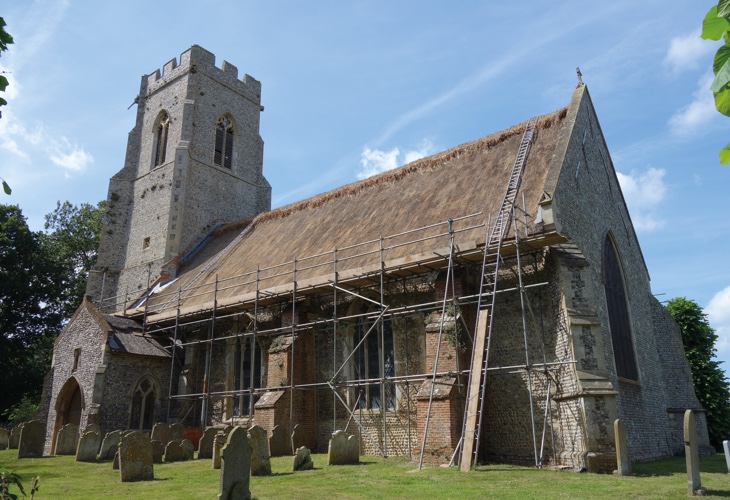
As some of you may have read in my last blog, I started a list of church features and furnishings along the lines of the classic I-Spy series of books from the 1970s. The list was partly inspired by my enthusiastic, but not particularly knowledgeable, family who were looking for a simple guide as I encouraged them to join me on various church crawls. One caveat – the list is not for the expert, and it does not cover everything, a task best left to the wonderful writers on Norfolk churches such as Simon Knott or D.P. Mortlock.
☐. BRASSES and LEDGER STONES
As you move down the nave eastwards, it pays to drag your gaze away from the plethora of stunning roofs in Norfolk’s churches and cast your eyes to the floor. More often than not, along the nave floor and into the chancel, you will find massive, dark slabs decorated with crests and epitaphs. These are ledger stones. Occasionally, you might also see medieval brasses, or at least the indented outline of where they once rested.


Although originating in different periods, brasses and ledger stones essentially served the same purpose: a memorial and often the burial spot of a distinguished, and wealthy, member of the congregation. Monumental brasses were at their peak popularity from the 14th to mid-17th centuries. Made in an alloy called latten, a mixture of copper and zinc, the metal was produced chiefly in Cologne, where it was beaten into plates and exported to Britain and the Low Countries. Along with being memorials, these brasses are great records of our customs, dress, fashion and military armour and Norfolk is fortunate to have a large number spread around the county. The Minster in King’s Lynn has some of the largest and finest, along with St Margaret, Felbrigg. One of my particular favourites is of two babes in swaddling at St Mary, Rougham. When visiting churches, it is worth bearing in mind that the brasses are often hidden under old carpet for protection or have been removed and attached to the walls.


By the end of the first half of the 17th century brasses declined in popularity to be replaced by ledger stones. The name is from the Old English, lygger, meaning ‘to lie down’ and they are usually made of black marble from Tournai in modern-day Belgium. Often showing heraldic devices and memento mori (reminders of mortality), the written epitaths are an amazing historical record and can be extremely moving, as shown in the examples here at St John the Baptist, Mileham and All Saints, Marsham
☐. PULPIT


Pulpits are usually found on the north side of the east end of the nave, the name deriving from the Latin word pulpitum meaning ‘platform’ or ‘stage’. After the Reformation, as preaching became increasingly important in church services, the pulpit assumed a more prominent role in worship. There are, however, many fine medieval pulpits around the county. Most of these medieval pulpits are of a general ‘wine glass’ type such as the breathtaking examples at St James, Castle Acre and St Margaret, Burnham Norton. Hexagonal in shape, they are beautifully painted with representations of the Four Latin Doctors of the Church (St Ambrose, St Augustine, St Gregory and St Jerome) and seem impossibly delicate and narrow. There are many other stunning examples from the 17th and 18th centuries, such as the two- and three-decker pulpits which include a reader’s platform and a clerk’s desk. The pulpit at St Martin, Thompson, shown here, is a striking mish-mash of styles.

☐. ROOD, ROOD BEAM, ROOD LOFT, ROOD LOFT STAIRS, ROOD SCREEN

Norfolk is blessed with a multitude of beautifully painted rood screens. These were just part of a more elaborate construction, much of which no longer exists. Before the Reformation, churches were generally divided between the chancel, principally used by the clergy, and the nave, where the congregation gathered. To ensure this physical and spiritual separation, a wooden, often elaborately carved screen stretched from pillar to pillar beneath the chancel arch. Above was the rood beam which supported a rood loft on which was placed the rood itself, a great crucifix with images of St John and the Virgin Mary on either side. Access to the loft was via the rood loft stairs of which the remains are in evidence in hundreds of our churches.


During the Reformation, the roods and much of the associated religious imagery were removed or destroyed. However, many of the screens themselves survived, despite subsequent iconoclastic action. Nearly one hundred of these screens, elaborately painted with many different saints, still survive in Norfolk. The Broads area has many fine examples, but there are many others too, such as at St Giles, Houghton St Giles and All Saints, Edingthorpe.
☐. MISERICORD
Passing under the chancel arch, you will often come across the choir seating, a haven for wonderfully carved poppyheads and occasional graffiti. Among the seating there may be medieval misericords, the name deriving from the Latin word for ‘mercy’. This is
a seat that hinges up to form a shelf on which elderly monks could rest while standing for long periods during services. The underside of the seats was carved in a beguiling mixture of saints, heraldry and many irreverent, pagan figures much like the gargoyles and grotesques in evidence elsewhere. Pictured here are examples from The Minster, King’s Lynn and St Nicholas, North Walsham.


☐. SEDILIA and PISCINA
The sedilia on the south side of the chancel, recessed into the wall, provided the seating for the clergy. Sometimes the seats are all on the same level and at other times they are stepped to reflect the church hierarchy – the priest, the deacon and the sub-deacon. They might be enclosed by gothic arches and elaborate stone carving and pillars. Many survived the Reformation as they were deemed utilitarian and unconnected to ‘Roman’ worship. Some seem impractically low, but this is usually because the floor of the chancel has been raised during restoration work.


Alongside the sedilia and near the altar, and often mimicking it in style, you will find a piscina. This is a basin and drain that were an integral part of the Mass. The communion vessels were washed and, importantly, the water would run away into the consecrated ground of the churchyard. Some piscinas also have a credence shelf set above them in the alcove.
Examples here are St Martin, Thompson and St Andrew, Themelthorpe.
☐. EASTER SEPULCHRE


On the north side of the chancel, you will sometimes come across an Easter Sepulchre recessed into the wall. These range from simple to richly carved and canopied and are also known as the Tomb of Christ. On Maundy Thursday, the consecrated host was placed in the sepulchre, where it was watched over day and night, until Easter morning, when it was removed and consumed during the Easter mass. The vessels were then returned to the altar. This was to represent the burial and resurrection of Jesus. Many were destroyed during the Reformation, and some were transformed into tombs for the local dignitaries. Examples here from St Mary, Kelling and St Mary, Baconsthorpe.
In conclusion, my I-Spy list across the last two blogs is a gentle introduction for those interested in Norfolk’s incredible array of churches and merely a starting point for the curious. There are many omissions, no doubt a few glaring ones, but I hope at least my own family will be better informed on our next foray into the county’s rich heritage.
Rob Gladstone November 2026