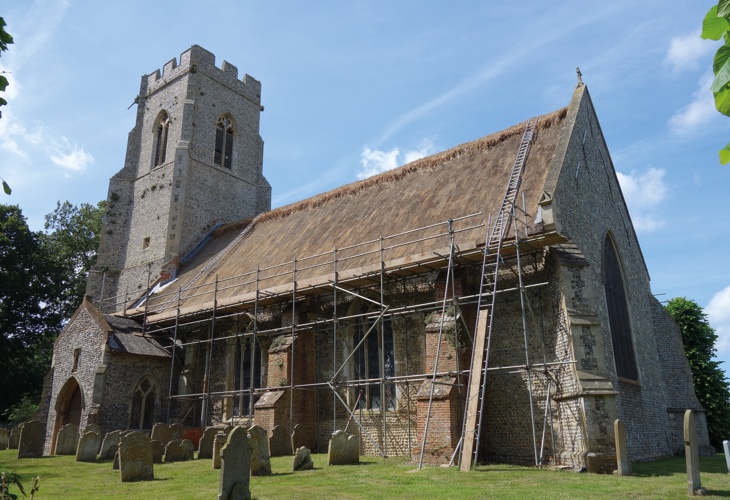
A special Choral Evensong took place on Wednesday 17th June at Norwich Cathedral to celebrate 50 years of the Norfolk Churches Trust. During the service, we were honoured that the address was given by Dame Emma Bridgewater, for which we are most grateful.
Here we reproduce a copy of that address.
A vivid memory from my childhood in the 1960s is of ragging on the back seat of Mum’s blue Singer car, there would have been many more children than seats, no seatbelts, and the hope of a trip to the beach: meanwhile Mum is chatting in the front with her friend Candida Lycett Green; those summer holidays were very often in Norfolk, (and sometimes Cornwall). And all too often, with the beach almost in sight, they would stop the car, reverse and pull onto a grassy verge, already both focussed on what was to us a waste of valuable summer holiday time – namely hanging about in a musty old church whilst they exclaimed about wall painting, pew ends, green men etc etc and encouraged us to look for our names on the memorials on the floor.
We moaned and complained and they entirely ignored us, because they were church crawling, which was one of their most favourite things. But as far as we were concerned, it was a sure way to make children very bored. Wind the clock forwards thirty years and it’s my children in the back of the car, and then quite possibly lurking sulkily in the very same church- maybe Glandford, or Cockthorpe or Burnham Overy Town, making EXACTLY the same complaint.
So, it works!
Inoculate children with church crawling when they are still in your power, and chances are the habit will stick with them for life.
Actually, you can use this ruse on your friends quite effectively as well, particularly the ones who make an absolute refusal at the notion of religion and church: I find it goes down well with all sorts of unbelievers when I propose a picnic in a church. Give it half an hour ( and some delicious pork pies, a bowl of strawberries and a thermos of coffee and a bar of chocolate!) and then I promise that they’ll be won over by what they are seeing. Because in terms of atmosphere, and of ancient art and craftsmanship our Norfolk churches are of world class, no doubt about it, and if the 660 or so churches of Norfolk were in a nearby foreign country, well I have no doubt we’d be forever discovering, collecting and eulogising them…
It is sad (and mad!) that so many of them are lonely, unvisited and in danger of closure. One way or another, let’s all encourage more people to visit our churches because they are patiently waiting for us all, full of treasures, surprises and history…!
We are here today to celebrate 50 years worth of top quality fun fund raising inspired by the Norfolk Churches Trust. No one here needs telling that the founder, inspiration and historic force in this organisation was Lady Harrod, Billa, and you’ll all of you who knew her understand that I’m absolutely knocking at the knees as to whether what I am about to say sits well or ill with her ghost, as she might make her disapproval known if I get this wrong…watch out for thunderbolts, or maybe even expletives.
When I dragged Matthew and our two small daughters to norfolk in 1994, the thought of Norfolk’s powerful tribe of impressive female elders had a strong attraction for me – including Billa, but also including Chloe MacCarthy, Mary Athill, Stella Mott Radcliffe my wonderful granny Phyllida Pumphrey, and Bridget Buxton, who’s still my muse to this day!
These women were all very kind and inspiring to me in different ways, broadly because they knew all the best and most important things about Norfolk, and the wider questions about making life rich, meaningful and lovely. Billa in particular represented a no nonsense, no question of failing, get on with it type of energy and purpose which I always wished very much to emulate. I was also wowed by her utterly original taste – that turquoise hall, the huge pillow of snowdrops in a wide bowl on a table, and her idiosyncratic museum with its oddities and unlikely ephemera.
I think we are very fortunate that the NCT is hallmarked with her effective and distinctive style – which I have often reached for in my own work, she has been a significant silent mentor to me at times when I’ve found my courage, inspiration or determination flagging in the Potteries over the past 40 years.
Mum’s friend Candida was the daughter of John Betjeman, and he was one of Billa’s closest friends; so whilst I don’t actually know this I can vividly imagine him accompanying her along hundreds of miles of norfolk lanes laughing and chatting on their lifelong church crawl – in particular as she researched the Shell Guide to Norfolk, published in 1952. And Candida’s childhood in turn included much church crawling…
The Shell Guide is still a great handbook for exploring Norfolk; and it is Billa’s characteristically economic and elegant eulogy to our county’s wealth of parish churches and their stunning architectural qualities – which helps us to focus on her concern for the upkeep of the fabric of Norfolk’s churches, and so to put this aspect of the Trust out in front.
Of course, the NCT fundraising is legendary and heroic, and I feel enormous admiration and gratitude for the combined efforts of every single person here today: this Trust is the body which has united us to splendid effect in a hugely significant conservation project.
But.
Let us NOT forget the other side of the coin; the decay and closure of our churches represents now, as in 1976, a direct challenge to the health and strength of our Christian faith – and my belief is that Billa minded about this as passionately as she loved the beauty of our churches in our landscapes, villages, market towns – and in our very fine city of Norwich.
So. When the Bishop here proposed in the early 1970s that several of Norwich’s city churches must close and either remain closed or find new uses, this was the spark that lit the fire within Billa, and led to the formation of this trust whose purpose was at heart to maintain ALL of Norfolk’s churches primarily for their original purpose as
!!Places of Worship!!
… Or as many as she possibly could. Woe to any rector or Vicar facing dwindling congregations and a leaking roof who tentatively suggested that such and such a church should be made redundant, she fought hard against closures and I believe we must uphold this element of her legacy.
Billa’s strong feeling was that churches should remain as churches even if their parishioners had all died or moved away, long since… Matthew and I were sometimes dragooned (willingly, luckily, as there was no possibility of dissent) into supporting local Patronal Festivals – which were her sensible and pleasing solution for keeping a lonely church warm and loved – by having at least one proper communion service, every year. With hymns.
So Matthew would skip about to find a piano, and some strong chaps to help him to drag it into the church, and then cajole a piano tuner (vital!) to attend just before the service so he could lead the hymn singing … such was Billa’s power.
And as I get older, I realise that I feel the same about this.
Every parish church MATTERS, regardless of status, size, architectural merit or even perhaps, if it no longer has any parishioners… From the tiny Norman church of St Mary’s at Newton by Castleacre to the splendour of Walpole St Peter in the Fens… Be it well attended, or completely alone in a field…
For, Each and Every church is the place where as TS Elliot says of Little Gidding ‘prayer has been valid’. Which is to say, Each and Every church is the repository, the accumulation of centuries worth of prayer, offered up by parishioners since the day of its consecration; it has been the spiritual focus for its parish, the place where the community has participated as a congregation in the centuries-long chain of worship, communion and devotion – and the celebration and record of countless local lives.
I find that this history of faith and community has an effect which is distinctive, as well as specific to each church.
As I push open the door of a church, step forward, take my first breath: I feel it. There is an inaudible hum, an invisible glimmering, a moving stillness: a palpable affecting atmosphere that speaks silently, insistently. This is, to me, the humming of the fine gold wire of collective faith, drawn out since the dawn of human spirituality…
And if we consider that many churches are built upon ancient pre-Christian sacred sites, incorporating earlier notions of faith and meaning, so it may be that the gold thread is a profound human connection with our very very distant past. It wears thinner as our spiritual lives dwindle, and it glows again when prayer and devotion are renewed.
In the 50 years since the Trust began its work many more Britons have turned aside from practising their faith regularly, sad to say, and the number of worshippers in our churches every Sunday has dropped, and keeps dropping, and the church has not always succeeded in holding our restless attention.
But I do not believe that this means that faith has gone. Instead, perhaps the Church will continue to evolve its offering? And. I think that there just might -in a national sense- be a coming need for us to discover and renew our spiritual lives, as well as strengthening our sense of community – particularly in the face of baffling technological developments and their effect upon our spirits.
And where better for this re awakening to happen than in our churches? Surely this is what they were built for, the power they hold?
Maybe we can tap into the power of historical prayer to find contemporary spiritual solace: with an evolving practice to relate our faith to the ways in which many people are now seeking spiritual growth and community, outside the church…
How about
*Silent Services, incorporating meditation and prayer.
*Church Community Feasts on high days…
*And also perhaps just regular meals for communities to sit down together, and to address the sad epidemic of loneliness.
*As well as facing up to local food poverty, by working hand in hand with the local Food Bank.
*A Requiem at All Saints in November, in every parish.
*Pilgrimages, beginning with services of dedication and ending with celebration services- in our churches.
I can’t wait.
Dame Emma Bridgewater 17th June 2026