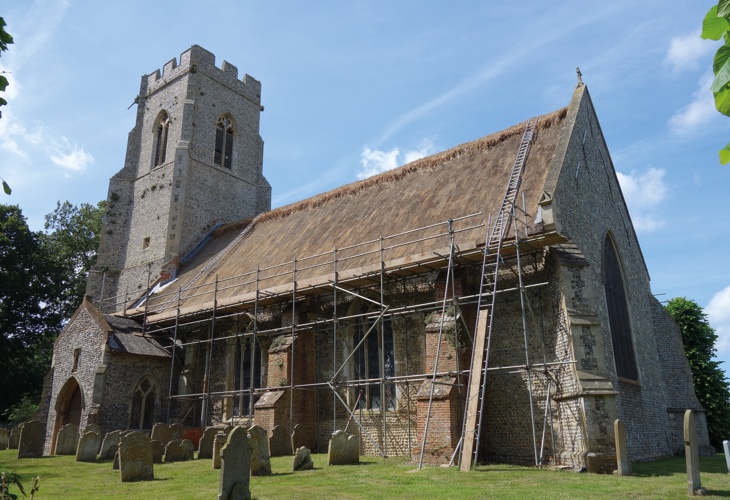
As I visit more and more of Norfolk’s vast array of churches, one simple question becomes harder to answer. What’s your favourite church? One month it may be the splendour of Walpole St Peter, the next the bucolic charm of Little Snoring. Quite honestly there is no real answer apart from, “well, this week it’s ….”. This is the joy of church crawling in this extraordinarily rich county. Perhaps the better question is, why do you love this church?
The answer is manifold and complex. It is a combination of the architecture of the building, the way the church sits in its environment, that great unquantifiable – ‘atmosphere’, the furnishings inside and the history that is imbued in every brick. St Martin’s, Thompson meets all these criteria in spades and, as I visited it very recently, it tops my list this week! Simon Jenkins’ wonderful “England’s Thousand Best Churches” lists 65 churches in Norfolk and doesn’t mention St Martin’s, showing how subjective the whole debate can be. I side with other Norfolk church aficionados, such as the late Tom Muckley, who have it very near the top of their lists. St Martin’s ticks every box of what makes a church particularly special.

I had been planning to visit St Martin’s for some time, but I was kicked into action by an unlikely source, a Sikh princess called Sophia Duleep Singh. Kensington Palace is currently holding an exhibition on this extraordinary woman and the five women who shaped her life. A prominent suffragette, World War I nurse and, along with her sister Catherine, a harbourer of many Jewish refugees from Nazi Germany. Her equally fascinating brother, Prince Frederick Duleep Singh, is intricately linked to St Martin’s church as we will discover below.
St Martin’s, Thompson, lies in the ancient, sprawling landscape called the Brecks in south-west Norfolk. Close to STANTA, the restricted military area, it is a quiet, remote area with many little roads leading only to closed gates warning you to go no further. This area was commandeered by the army in 1943 and the villages evacuated. Despite promises of a return the residents have never been let back. The church sits outside the small village accompanied by a small cluster of buildings.
A stunning sight in its attractive churchyard, St Martin’s is almost entirely the work of the Decorated and Perpendicular styles of the 14th and 15th centuries. The name of St Martin, a popular Saxon saint, indicates there might have been a church here previously, but there is no evidence of a structure and no mention in the Domesday book. The story of the church really begins at that most cataclysmic period in medieval history, the Black Death.


In1349, perhaps as a reaction to familial death, St Martin’s was endowed as a Collegiate Church by the local landowners, John and Thomas De Shardelowe. This included the creation of a separate college building a short distance away as a residence for six priests. This endowment was to last in perpetuity and ensured that priests would say prayers for the souls of the family and speed their passage through purgatory. The events of 1541 were to end this period of prosperity and following the dissolution the priests were thrown out and the church fell on hard times. It wasn’t until the mid-17th century that the church was saved from disaster, and this is so wonderfully evident inside the church.

On entering the church through the large 15th century porch, you come to the magnificent medieval door. The enormous wooden lock apparently requires a 13-inch key and the door creaks invitingly to reveal a stunning interior. The light floods through the clear windows and reflects off the silvery wood and ancient stone floor. The total silence is only broken by the hypnotic tick-tock of the clock’s pendulum that swings in the north end of the nave.
Standing and looking eastwards down the nave the full beauty of the church reveals itself. A stunning 5 cant scissor-braced roof dating from the 14th century rises above you, one of only two in the county. The medieval font sits quietly in the north-west corner, rather endearingly covered in little knitted mice that appear around the church. The ancient pews are from the 15th century and during the 17th century restoration carved poppyheads were added to the ends.

There is one remaining box pew on the left of the nave and opposite a delightfully idiosyncratic triple-decker pulpit. An elegant wine-glass pulpit from the 15th century has had later additions for the sexton and clerk simply bolted on. Behind it, separating the nave from the chancel, is a beautiful 14th century screen with elegant tracery and a gabled entrance. The colourful medieval paint is still very faintly visible.
The wonders keep coming as you move into the chancel. A few stalls from the collegiate days survive and a couple of the misericords carry the coat of arms of the De Shardelowe family. Two also have the faces of a woman and a bishop staring out. The initials JP are carved into one of the stalls. This is thought to be one John Pory, who went out to Virginia in 1619 and helped set up the Legislative Assembly of Virginia, America’s first such body.

Other highlights include the tall, decorated windows, the upper tracery on the north side filled in at some stage to save costs. There is a beautiful sedilla and piscina, the elaborate faces of Green Men staring out from the spandrels. The altar rails are from the seventeenth century, the time when Archbishop Laud was making changes to church liturgy that many perceived as papist. These rails are unusual in having a ledge which may have held prayer books for those kneeling at the altar.


Moving back into the nave on the south side is a small transept chapel, probably intended as a chantry chapel. Here is a modern plaque on the wall recognising the contribution of Prince Frederick Duleep Singh, the brother of the suffragette, Sophia Duleep Singh. It was the prince, third surviving son of the Maharajah Duleep Singh, who underwrote the costs of the restoration of St Martin’s in 1911. A passionate historian, collector and believer in the sensitive restoration of ancient buildings, Frederick spent much of his childhood at nearby Elveden, the country seat of his father. He fought in WWI with the Norfolk Yeomanry and was the East Anglia representative of The Society for the Protection of Ancient Buildings (SPAB). A devout monarchist, it was said he had a portrait of Cromwell hung upside-down in his lavatory!
For this week, anyway, St Martin’s, Thompson, is my favourite church. Who knows how I will be feeling by the time I write my next blog!
Rob Gladstone March 2026