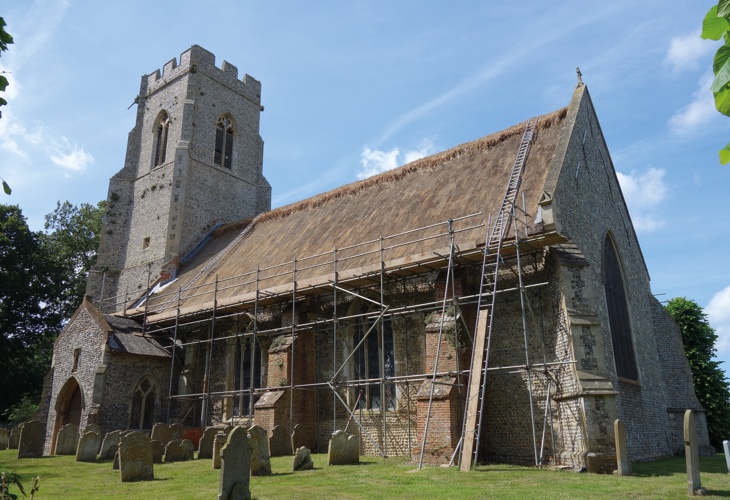
Leaving behind the ancient earthworks of the motte and bailey at Castle Acre, I walk down the hill into the lush water meadow bordering the languid River Nar. The feeling of anticipation grows as I cross a small bridge and climb up towards the busy Fakenham-Swaffham road. My destination is All Saints, Newton-by-Castle-Acre. I think I know what I am going to find; after all, I must have driven past hundreds of times on the busy A1065, but I wasn’t expecting something as wonderful as I discovered as I rounded the corner.

If you want to go on a whistle-stop tour of medieval Norfolk in a day, there can be nowhere better than the village of Castle Acre. Its remarkable buildings span the whole period from the Norman Conquest to the Reformation, and everything is set in the bucolic backdrop of stunning countryside. Set on a hill above the River Nar, the village is one of only a handful that is on the Peddars Way. This ancient route runs for 46 miles from Suffolk to the Norfolk coast and must have once been bustling with pilgrims on their way to the Shrine of Our Lady of Walsingham. This small Norfolk shrine was for much of the medieval period considered only less in importance than Jerusalem, Rome and Santiago de Compostela.

The day I visited there was a very small trickle of visitors. I couldn’t help wondering whether, had I been in a similar spot in the Home Counties, it would have been heaving with day-trippers. This remoteness and solitude does not reflect the importance of the area in the Middle Ages. Norfolk was one of England’s most populous counties and the stretch of the Nar heading towards Narborough and joining the Great Ouse at King’s Lynn has been called Norfolk’s ‘Holy Land’ because of the high concentration of priories and friaries along its banks.
Most people come to see the wonderfully preserved ruins of the Priory, castle and Bailey Gate, three medieval masterpieces within a few minutes walk of each other. There is evidence of a Roman fort here long before the Norman arrival and a Saxon lord called Toki is known to have been in possession before that fateful day in 1066. As with most of his class, Toki was dispossessed by the new Norman regime. The new lord was William de Warenne, who had married Gundrada, the daughter of William the Conqueror. De Warenne was hugely enriched by the conquest, having large estates in Sussex and Yorkshire, and later being raised to the earldom of Surrey.
William de Warenne quickly began the construction of the castle and it was complete by 1085. The huge ramparts are still very evident today. Around this date the Earl brought a small community of Cluniac monks to Castle Acre from his earlier foundation in Lewes and work began on the priory. This was not finished until 1146-48, but over the following centuries the priory grew until everything came to a grinding halt on 22nd November 1537 when the deed of surrender was signed. Over the years much of the masonry was acquired for other projects leaving the picturesque ruins we see today.

The church of St James The Great stands just to the west of the outer bailey of the castle and overlooks the priory ruins. A large, elegant church, most of the building you see today is from 15th century, including its impressive tower and porch. One curiosity lies on the south side of the chancel wall, a high Norman arch showing in the brickwork above an early Gothic door. The local story is that this may have been an opening large enough for a knight in full armour to ride into the sanctuary to be blessed before battle. As Simon Jenkins playfully comments, this makes St James ‘the world’s first drive-in church’!
The interior is vast and airy and has several fittings of interest. In the west end is a towering 15th century font cover, much of its red, green and gold paintwork uncovered in recent restoration. Behind the font are the decalogue boards displaying the Ten Commandments cleverly relocated to form a screen. Looking east down the nave the church is lit by the large, mainly perpendicular windows and clerestory.

Your eyes are drawn to the area between the nave and chancel where the remains of the fine rood screen spread out before you. This features the 12 apostles, the paintwork much restored by the Victorians.
Of particular interest here is St Andrew, the image seemingly peppered with lead shot. The church guide suggests this was probably the work of armed puritans in the Civil War, but Simon Knott’s explanation is far more fun. In his opinion this is the work of over-zealous bird control.
In the 17th and 18th centuries many churches had fallen into disrepair and there were often problems with birds, particularly jackdaws, nesting inside the church. He gives examples of church records where people were paid to shoot birds, in South Creake pellets have been found in the angel roof.


Standing next to the dado screen is a beautifully preserved hexagonal pulpit on a wine glass stem. On four of the panels are the richly painted images of the Four Latin Doctors: Saints Augustine, Jerome, Ambrose and Gregory. The remaining panel is blank but could possibly have once displayed the names of the donors.
Passing through into the chancel, the hammerbeam roof is original, dating from the 15th century. There are some lovely misericords in the stalls and good examples of 14th century poppyheads adorning the bench ends. High on the north wall is a small window where a skull stares out, daring you to come closer.
Down the hill and out of the village, the small, perfectly formed church of All Saints, Newton-by-Castle-Acre, could not be more different to St James’s. With its jauntily capped tower and red tiled roof, All Saints has an unusual appearance, more Loire Valley than Nar Valley. The door creaks open and welcomes you into a beautifully simple interior, all uneven floors and walls, stained green by damp and Father Time.

Originally a cruciform church, the transepts have long disappeared, and the overall impression is of a late Saxon/early Norman church. The font and window tracery are from the 14th century and simple modern pews blend in pleasingly. Looking down the short nave, the first arch is from the 14th century and has the coat of arms above. There is also a door which would have entered the roodloft and a curious late Saxon/early Norman window. Moving east, the chancel arch is clearly more basic and probably also late Saxon.


I sit on a plain, dusty pew for a minute and let the sense of timelessness wash over me. Castle Acre is truly a wonderful, historical time capsule set in a heavenly landscape. But this small, largely ignored church on the side of a busy thoroughfare is what delights me the most. This is the sort of place I seek out on my church crawling, and I cannot wait to find the next jewel in this wonderful county.
Rob Gladstone May 2026