

My historical wanderings are predominantly in Norfolk, and especially Norfolk’s churches, but given the opportunity I like to seek out places of interest wherever I am. Few areas are richer in our history than the City of London and its surrounds. I was recently walking across Southwark Bridge when I bumped into my thirty-something nephew as he cycled home from work. Once the initial amazement at our paths crossing in the busy rush hour had passed, he asked me what I was doing. When I replied that I was looking for the last remaining seat of the ferrymen who once traversed the Thames, I realised that, in his eyes, my level of eccentricity had just gone up a notch.
Most visitors to London will seek out the large, impressive sights such as St Paul’s Cathedral, or stop off in one of the world-beating galleries or museums. Wonders though these are, and well worth visiting, it is the small, quirky places and objects that fuel my interest. And the same is true in Norfolk’s wide array of churches. The magnificence and beauty of the architecture and interiors of churches such as Salle or Trunch never cease to dazzle, but almost every church I go into has something small and intriguing, often with a little-known story attached. Listed below are a few of my recent highlights from church wanderings.
St Helen, Gateley – Sir John Schorne

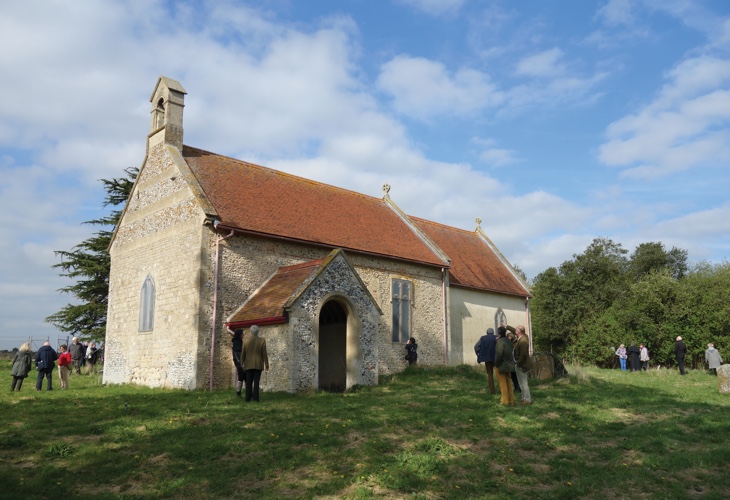
St Helen, is a small, atmospheric church that hides secretively in the lanes near Brisley. With its medieval nave and a chancel mainly rebuilt in the 19th Century, the interior is cool and open with some medieval furnishings and a few lovely surviving pew ends. The star of the show is the 15th century rood screen panels, rich in original colour and depicting eight intriguing characters. On the left are four women: St Audrey, St Elisabeth, The Blessed Virgin and The Mistress of Ridibowne (a local saint and the only depiction of her still known to exist). On the right are St Louis, Henri VI, St Augustine, and Sir John Schorne. This delightfully cartoon-like image, in the main photograph, shows Sir John either pushing in or coaxing out the devil from a boot. He gained a particular reputation for helping to cure gout. Although never officially canonised, he was held in such high regard his body was exhumed and transferred to St George’s Chapel, Windsor in 1448.
All Saints, Narborough – Clement Spelman

All Saints is a 15th century church much ‘improved’ by the Victorians. The church is rich in monuments and brasses, many to the legal family, the Spelmans. One brass commemorates Sir John Spelman (1545), a Justice of the King’s Bench, who took part in the trial of Sir Thomas More and helped prepare the indictment against Anne Boleyn that led to her execution.

Two monuments in particular catch the eye. Sir Clement Spelman and his wife lie casually, but somewhat uncomfortably, one above the other, watched over by their kneeling daughter and their infant son in his cot. A glance around and here is the baby, fully grown and looking rather aloof in his judicial robes as Recorder of Nottingham. Clement Spelman seemed to have rather grandiose ideas as originally his body was coffined upright within an 8-foot pedestal positioned in the middle of the chancel. Pevsner alleges this was because the proud lawyer didn’t want to be walked all over. The Victorian restorers cut him down to size by getting rid of the coffin, reducing the pedestal and shunting him to one side. Ouch!
St John the Baptist, Mileham & All Saints, Marsham – Ledger Stones
Reading the inscriptions on memorials and ledger stones often gives us a direct understanding of some of the numerous people who lived and died in these churches. Clearly most relate to the great and the good as so many would have died largely unmarked. There are thousands of poignant, and occasionally rather pompous, epitaphs, but the two here I found particularly moving.

In Mileham, four stones sit side by side and record the tragic, but surely not unusual, story of the children of Thomas and Elizabeth Browne. The first stone lists the four children: Thomas, William, Mary, and John. The second lists their birth dates in consecutive years, 1677, 1678, 1679 and 1680. The third lists their baptism dates, and the fourth the dates of their deaths – all within a few weeks of their birth. Such a loss must have been hard to bear.

At Marsham a simple ledger stone to Sarah Bear reads;
“To die I must,
To stay I’d rather,
To go I must,
I know not whither.”
A sentiment that resonates with many today.
St Mary, Great Snoring – WWI grave marker

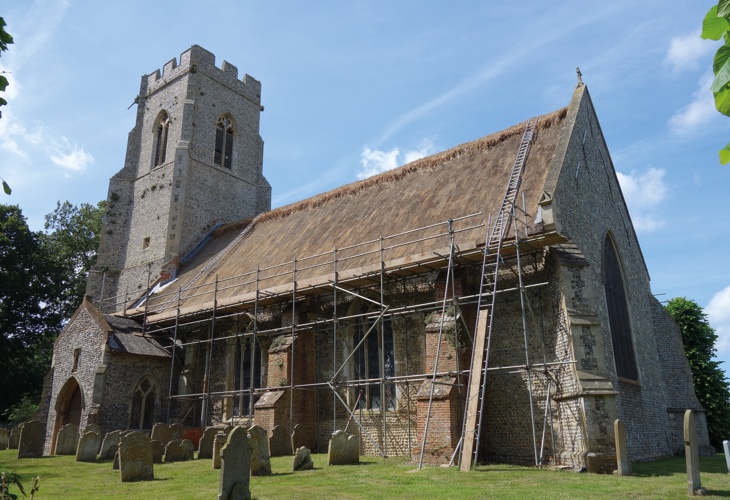
St Mary is a large, impressive church with a square, 15th Century tower, two storeys of which were once used as a priest’s living area and included a fireplace and privy. The interior has a fine screen and many other lovely features.
On the wall is a simple wooden cross to Lieutenant C R Bayley of the Royal Field Artillery, killed in action on 29th March 1918. The cross marked his grave on the battlefields of the Western Front. Thousands of these crosses were returned to the soldiers’ home parishes, but most were later replaced with more permanent memorials, and few survive in churches today. What makes this cross particularly poignant is that it was varnished as soon as it was lifted and the Flanders mud is still visible under the varnish.

As for the ferryman’s seat? I found this last remaining artefact set into the side wall of a pizza restaurant, a stone’s throw from Shakespeare’s Globe Theatre. Small, hidden away but wonderfully evocative of London’s past.

Rob Gladstone November 2025