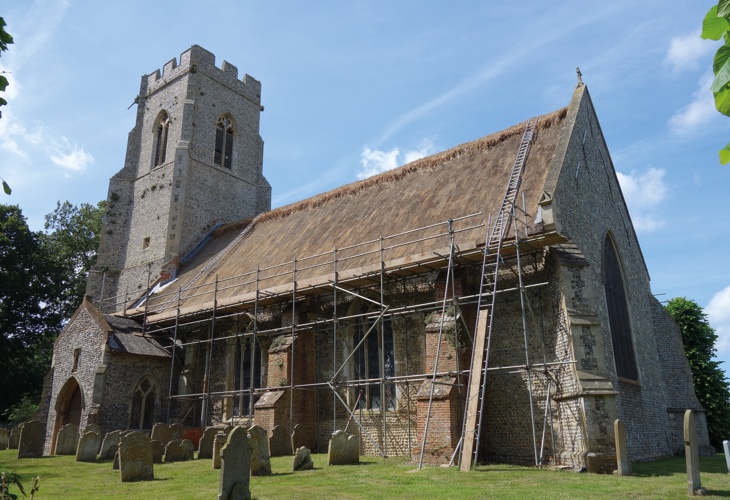
On Saturday 11th April a group of members of the Norfolk Churches Trust attended Justin Nolan’s Elephants and Squirrels, Arcades and Tracery Tour. Taking in two distinctive, but very different Grade I listed churches in South Norfolk namely, St Andrew, South Lopham and St Peter and St Paul, East Harling. The tour took us from the Anglo-Saxon period to the dawn of the Reformation, looking at why these churches were located where they were, and who were the people who funded them.


Starting at South Lopham, we first looked at the exterior looking for historical clues in the fabric of the building. A circular Saxon window in the north wall indicated that there was an earlier church here before William Bigod built the one we see today.
The impressive, central Norman tower, built circa 1120, points to the probability that a larger church with transepts was planned here.
Inside, Justin’s extensive research provided more historical context to this church, and why it may not have become as important as it was intended to be, with other towns and cities becoming more influential.
Just behind Justin’s left shoulder you can spot the eponymous elephant, part of a 15th century bench end of an elephant and castle, a symbol of power and authority.


A short drive took the group to East Harling, St Peter and St Paul. Here we were introduced to Anne Harling, who funded the building of the current church (along with her first two husbands) in the mid-15th century. Anne’s third husband added carved works to the tower parapet.
Anne had inherited the Harling estate as a child, and despite marrying three times she did not have children, the church instead her legacy.
The building contains impressive tombs and monuments to Anne and her three husbands. Anne herself rests with her first husband Sir William Chamberlain in the chancel where it joins the St Anne Chapel. The monument, pictured above, also served as the Easter Sepulchre.
Anne also provided for the magnificent east window, compared favourably to that at St Peter Mancroft in Norwich. Images of Anne’s first two husbands are depicted within the glass. The window has been removed twice and reinstated twice due to war, the first the Civil War, and then the Second World War. Here also can be found the ‘squirrel’ at the very top of this vast window containing Medieval glass.

The rodent, is a symbol of the Lovell family who took over the manor from the Harlings. Squirrels can also be found on the tomb of Sir Thomas Lovell and his wife in the south east nave chapel. This enclosed by a 14th century parclose screen.

Following the tour a delicious afternoon tea was provided by members of the church and there was time to look around the church spotting family symbols, Anne Harling’s family symbol was a basket and a corset!

Our thanks go to Justin, for once again giving us a fascinating insight into the social history contained with Norfolk’s churches.
As the tour took place on the day of the Grand National it seems appropriate that a horse was spotted on the choir stalls.