At the risk of enraging my old English teacher, I want to begin this month’s blog with a well-worn cliché, ‘Beauty is in the eye of the beholder’, simply because, when it comes to church crawling, it is fundamentally true. One person’s monstrosity is another’s delight. Much like faith itself, the spiritual and aesthetic impressions from a church visit are deeply personal. I can only guess at the number of times that Simon Jenkins has been pulled up for his choices in ‘England’s Thousand Best Churches’. And as for his one to four star rating, the man clearly lost all reasoning!
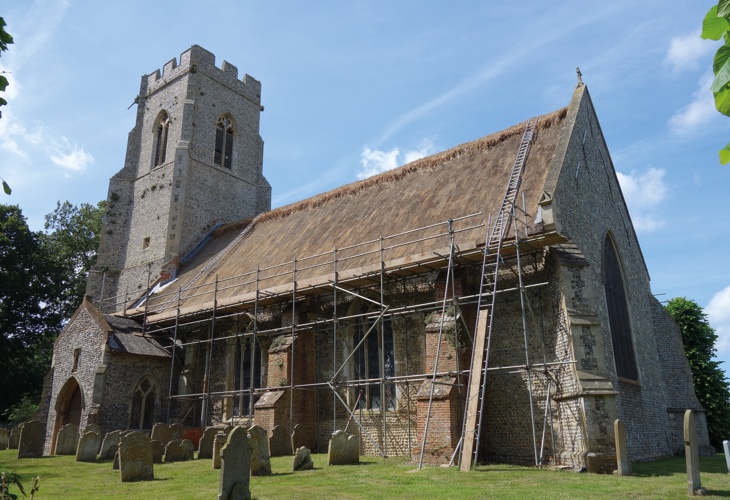
But why use just one cliché when another old chestnut can be thrown into the mix: the so-called ‘hidden gem’. We have probably all experienced someone letting us in on the secret to a hidden beach or knockout restaurant, but by the time we jump on the zeitgeist it is awash with instagrammers taking selfies. In practice, of course, there is no such thing. But when it comes to Norfolk churches, a surprising number are hidden in the real sense – they can be very tricky to find!

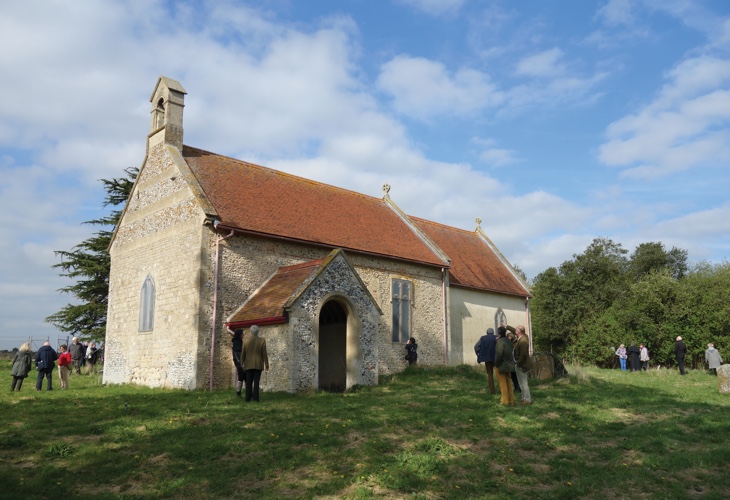
One church I have visited recently fits the category of being ‘hidden’, in my opinion is a ‘gem’ and has no mention in Jenkins’ book. I have driven past All Saints, Hilborough hundreds of times on the busy road from Fakenham to Thetford and had no idea that it was there. Unsignposted, the approach is down a country track, and you emerge into a gorgeous open space in front of the church. The day I visited horse chestnuts littered the ground, and the simple white gate invites you in. Gravestones stand sentry down the path to the lovely, 15th Century south porch, all faced with chequerwork of mellow stone and flint.

Moving round to the west doorway an even grander entrance comes into view. As Simon Knott points out in his brilliant Norfolk churches website, this was clearly intended as the main approach. The doorway is elaborately decorated, the striking figures in the spandrels depict a man of the woods holding a severed head and a nobleman wielding a sword. The pretty path lined with trees runs into the bucolic parkland that surrounds the church.

Sitting majestically in the sweeping grounds is Hilborough Hall, a Grade II listed house that was built for Ralph Caldwell in 1779. Ralph was agent at Holkham Hall, and his new abode shares several features with its illustrious predecessor, including Robert Adam’s-style interiors. The Hall has had several notable occupants, none more so than Lieutenant-General Arthur Richard Wellesley, 2nd Duke of Wellington, the son of The Iron Duke. Unsurprisingly in the great man’s shadow, he wrote these wonderfully self-deprecating words on his father’s death, “Think what it will be when the Duke of Wellington is announced, and only I come in.”
If one scion of a titan of British history was not enough, Hilborough also has strong connections with Norfolk’s most famous son, Horatio Nelson. Nelson’s father, Reverend Edmund Nelson was the rector here before moving on to Burnham Thorpe where the young hero was born. Indeed, between 1734-1806 all the rectors were Nelsons, bar one, and he sensibly married one! After his victory in 1801 at The Battle of the Nile, Nelson was created Baron Nelson of the Nile and Hilborough. The delicious thought of two of Britain’s most titanic historical figures worshipping at All Saints fills my mind as I enter through the south door.
The impression on entering is one of timelessness mixed with managed decline. Clearly, like so many of Norfolk’s wonderful churches, there is a tiny core of dedicated people who work hard to keep everything ticking along, modern day saints if you will. At the same time, this feeling of elegant depreciation often adds to the atmosphere that is so mesmerising, and All Saints is no exception. Soft light floods in and falls on the dusty 15th century pews. The solid poppy-heads act as staging posts for the intricate spider webs as they weave an almost invisible barrier to entry. Looking heavenwards, the medieval hammer-beam roof is a warm toffee colour. The angels would peer down on you, but unnervingly they have all been decapitated.

One of the wonders of the church now sits above the south entrance, a huge Royal Arms of James I, which bears the motto in Latin “Let God Arise and let his enemies be scattered”. Close by is the chunky medieval font and looking down the nave to the chancel one is struck by the large east window, which is lined, in Mortlock’s unforgiving words, “in strips of awful gaudy glass”. The eye of the beholder and all that!

The chancel roof has more melancholic disfigured angels and in the south wall a lovely 14th century piscina and sedilla. There are various memorials to members of the Caldwell family, including another Ralph, who died in Jamaica in 1831, aged just 25, a reminder of the numerous younger sons who ventured out and died in the Empire in its heyday.

Exiting through the striking white gate back into late afternoon sun, I feel glad to have discovered this ‘hidden gem’. I ruminate on this sense of the personal that makes visiting churches such a pleasure. For some it may be the wonders of the medieval masons, or the intricate skills of wood carvers, for others, it may be the dazzling stained glass or the ledger stones and memorials that tell the rich history of the past. Beauty is, indeed, in the eye of the beholder.

Rob Gladstone September 2025